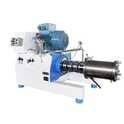
As a supplier of Disc Type Bead Mills, I am often asked about the processing capacity of these remarkable machines. In this blog, I will delve into the factors that influence the processing capacity of a Disc Type Bead Mill, explore its capabilities, and discuss how it compares to other types of grinding equipment.
Understanding the Basics of a Disc Type Bead Mill
A Disc Type Bead Mill is a high - energy grinding device used for the wet - grinding of various materials, such as pigments, coatings, inks, and pharmaceuticals. The mill consists of a cylindrical chamber filled with grinding beads (usually made of zirconia, glass, or ceramic). Inside the chamber, a series of discs are attached to a rotating shaft. As the shaft rotates, the discs agitate the grinding beads, causing them to collide with the particles of the material being processed. This high - intensity agitation leads to the reduction of particle size through impact, shear, and attrition forces.
Factors Affecting the Processing Capacity
- Motor Power
The motor power of a Disc Type Bead Mill is a crucial factor in determining its processing capacity. A more powerful motor can drive the shaft at a higher speed, which in turn increases the kinetic energy of the grinding beads. This results in more frequent and forceful collisions with the particles, leading to faster particle size reduction. For example, a mill with a 10 - kilowatt motor will generally have a higher processing capacity than one with a 5 - kilowatt motor, assuming all other factors are equal. - Chamber Volume
The volume of the grinding chamber also plays a significant role. A larger chamber can hold more grinding beads and a greater amount of the material to be processed. However, it's important to note that simply increasing the chamber volume doesn't always linearly increase the processing capacity. The ratio of the volume of the grinding beads to the volume of the material, as well as the proper circulation and agitation within the chamber, must be maintained for optimal performance. - Grinding Bead Size and Density
The size and density of the grinding beads affect the processing capacity. Smaller beads provide a larger surface area for interaction with the particles, which can lead to more efficient grinding. However, very small beads may be more difficult to separate from the processed material. Denser beads have more kinetic energy when in motion, which can enhance the grinding efficiency. For instance, zirconia beads are denser than glass beads and are often used for more demanding grinding applications. - Material Viscosity
The viscosity of the material being processed has a direct impact on the processing capacity. Highly viscous materials can impede the movement of the grinding beads, reducing the efficiency of the grinding process. In such cases, pre - treatment or the addition of solvents may be required to lower the viscosity and improve the flow of the material through the mill.
Measuring the Processing Capacity
The processing capacity of a Disc Type Bead Mill is typically measured in terms of the throughput rate, which is the amount of material that can be processed per unit of time (usually per hour). This rate can vary widely depending on the factors mentioned above. For example, a small - scale laboratory Disc Type Bead Mill may have a throughput rate of a few liters per hour, while an industrial - scale mill can process hundreds or even thousands of liters per hour.
Another important metric is the particle size reduction efficiency. This is measured by comparing the initial particle size distribution of the material with the final particle size distribution after processing. A high - performance Disc Type Bead Mill should be able to achieve a significant reduction in particle size within a reasonable processing time.
Comparison with Other Grinding Equipment
When compared to other types of grinding equipment, such as ball mills and attritor mills, Disc Type Bead Mills offer several advantages in terms of processing capacity.


- Ball Mills: Ball mills are large, slow - moving machines that use large balls for grinding. While they can handle large volumes of material, they have a relatively low energy efficiency and a longer processing time. Disc Type Bead Mills, on the other hand, operate at higher speeds and provide more intense agitation, resulting in faster particle size reduction and a higher throughput rate.
- Attritor Mills: Attritor mills are similar to Disc Type Bead Mills in that they use grinding media for size reduction. However, attritor mills typically have a different design and agitation mechanism. Disc Type Bead Mills often have a more streamlined design and can be more easily integrated into continuous processing systems, making them suitable for high - volume production.
Applications and the Role of Processing Capacity
The processing capacity of a Disc Type Bead Mill is crucial in various industries.
- Pigment and Coating Industry: In the production of pigments and coatings, a high - processing - capacity mill is essential for meeting the large - scale demand. The ability to quickly reduce the particle size of pigments to a fine level ensures better dispersion and color quality in the final product.
- Ink Industry: For the Printing Ink Grinding Mill sector, a Disc Type Bead Mill with a high throughput rate is necessary to produce large quantities of ink with consistent quality. The fine particle size achieved by the mill contributes to better printability and color saturation.
- Pharmaceutical Industry: In pharmaceutical manufacturing, the processing capacity of the mill must be carefully balanced with the need for precision and contamination control. A Disc Type Bead Mill can be used to grind active pharmaceutical ingredients (APIs) to the required particle size, ensuring proper dissolution and bioavailability.
How Our Disc Type Bead Mills Excel in Processing Capacity
Our company offers a range of Disc Type Bead Mills designed to meet the diverse needs of different industries. Our mills are equipped with high - power motors that provide the necessary energy for efficient grinding. The chamber design is optimized to ensure proper circulation of the grinding beads and the material, maximizing the processing capacity.
We also offer a variety of grinding bead options, allowing our customers to choose the most suitable beads for their specific application. Our technical support team can assist in determining the optimal combination of bead size, density, and other parameters to achieve the best processing results.
In addition, our Disc Type Bead Mills are designed with ease of maintenance in mind. This reduces downtime and ensures continuous operation, further enhancing the overall processing capacity.
Conclusion
The processing capacity of a Disc Type Bead Mill is a complex parameter influenced by multiple factors, including motor power, chamber volume, grinding bead characteristics, and material properties. Understanding these factors is essential for selecting the right mill for a specific application.
Our company, as a leading supplier of Bead Mill equipment, is committed to providing high - quality Disc Type Bead Mills with excellent processing capacity. Whether you are a small - scale laboratory or a large - scale industrial manufacturer, our mills can help you achieve your grinding goals efficiently and effectively.
If you are interested in learning more about our Disc Type Bead Mills or have specific requirements for your processing needs, we invite you to contact us for a detailed consultation. Our team of experts is ready to assist you in finding the perfect solution for your business.
References
- Perry, R. H., & Green, D. W. (Eds.). (2008). Perry's Chemical Engineers' Handbook. McGraw - Hill.
- Svarovsky, L. (1990). Solid - Liquid Separation. Butterworth - Heinemann.