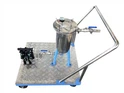
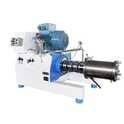
Hey there! As a supplier of Labaroty Basket Mills, I often get asked about how these mills stack up against attritor mills when it comes to production capacity. So, I thought I'd take some time to break it down for you.
Let's start with a quick intro to both types of mills. The Laboratory Basket Mill is a piece of equipment that's designed for efficient dispersion and grinding of various materials. It features a basket that contains the grinding media, which is lowered into the material to be processed. On the other hand, attritor mills work by agitating the grinding media with a shaft and impellers, causing the particles in the material to be ground down.
Production Capacity Basics
When we talk about production capacity, we're mainly looking at how much material a mill can process within a given time frame. This can depend on a bunch of factors, like the size of the mill, the type of material being processed, and the desired fineness of the final product.
Labaroty Basket Mill
One of the big advantages of the Labaroty Basket Mill in terms of production capacity is its relatively fast processing speed. The design of the basket allows for a large amount of grinding media to come into contact with the material at once. This means that it can quickly break down particles and achieve the desired level of dispersion. For example, if you're working with a high - viscosity material, the basket mill can handle it quite well. The basket can be customized in size, so you can choose a larger one if you need to process more material at a time.
The Basket Mill For Carotene is a great example of how the Labaroty Basket Mill can be tailored for specific production needs. Carotene is a sensitive material, and the basket mill can process it efficiently without causing too much heat build - up, which could damage the product. This is important because maintaining the quality of the product while maximizing production capacity is crucial.
Attritor Mills
Attritor mills also have their own strengths when it comes to production capacity. They are known for their ability to produce very fine particles. If you need a super - fine grind, an attritor mill might be a good choice. However, the process can be a bit slower compared to the Labaroty Basket Mill. The agitation process in attritor mills requires more time to achieve the same level of particle size reduction as a basket mill, especially for larger volumes of material.
Attritor mills are often used for applications where the quality of the grind is the top priority, such as in the production of high - end ceramics or some pharmaceutical products. But if you're looking to produce a large quantity of material in a shorter period, they might not be as efficient as the Labaroty Basket Mill.
Factors Affecting Production Capacity
Material Properties
The type of material being processed has a huge impact on the production capacity of both mills. For instance, if the material is abrasive, it can wear down the grinding media and components of the mill faster. The Labaroty Basket Mill can be equipped with different types of grinding media that are more resistant to abrasion, which helps maintain its production capacity over time.
In contrast, attritor mills might require more frequent replacement of the grinding media and impellers when dealing with abrasive materials, which can slow down production and increase costs.
Batch Size
Batch size is another important factor. The Labaroty Basket Mill can handle both small and large batch sizes quite effectively. For small - scale production or R & D purposes, you can use the Laboratory Basket Mill, which is designed for lower volumes. And for large - scale industrial production, you can opt for a larger basket mill.
Attritor mills, on the other hand, are better suited for continuous or semi - continuous production. If you need to process a large number of small batches, the setup and cleaning time between batches in an attritor mill can be a drawback, reducing the overall production capacity.
Energy Consumption
Energy consumption also plays a role in production capacity. The Labaroty Basket Mill is generally more energy - efficient, especially when processing larger volumes of material. The design allows for a more direct transfer of energy from the motor to the grinding process, which means less energy is wasted.
Attritor mills can consume more energy, especially when running for long periods to achieve the desired particle size. This not only increases the operating costs but can also limit the overall production capacity if you're working under energy - limited conditions.
Real - World Examples
Let's say you're in the paint manufacturing industry. You need to produce a large quantity of paint with a specific particle size distribution. The Labaroty Basket Mill can quickly disperse the pigments and other additives in the paint base, allowing you to produce large batches in a relatively short time.
On the other hand, if you're in the production of precision optical lenses, where the particle size of the raw materials needs to be extremely fine, an attritor mill might be more suitable. But keep in mind that the production rate will be lower compared to using a basket mill for a similar volume of material.
Conclusion
In conclusion, when comparing the Labaroty Basket Mill with attritor mills in terms of production capacity, it really depends on your specific needs. If you need to produce a large amount of material quickly, with a reasonable level of particle size reduction, the Labaroty Basket Mill is a great option. It offers fast processing, flexibility in batch size, and better energy efficiency.


However, if you require an extremely fine grind and are willing to sacrifice some production speed, an attritor mill might be the way to go.
If you're interested in learning more about how the Labaroty Basket Mill can meet your production needs, or if you want to discuss the best option for your specific application, feel free to reach out. We're here to help you make the right choice and boost your production capacity.
References
- "Industrial Grinding and Dispersion Equipment" - A technical guide on various grinding mills.
- "Materials Processing Handbook" - Covers the impact of different mill types on material production.