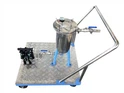
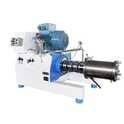
As a seasoned supplier of Gravure Ink Bead Mills, I've witnessed firsthand the diverse needs and inquiries from our clients. One of the most frequently asked questions revolves around the differences between horizontal and vertical gravure ink bead mills. In this blog, I'll delve into the distinct characteristics, advantages, and applications of these two types of bead mills to help you make an informed decision for your specific requirements.
Working Principles
Let's start by understanding the fundamental working principles of horizontal and vertical gravure ink bead mills.
A horizontal bead mill operates with a horizontally oriented grinding chamber. The rotor inside the chamber rotates at high speeds, causing the grinding beads to move in a complex motion. This motion generates intense shearing and impact forces, which break down the particles in the ink. The ink is continuously pumped into the chamber from one end and exits from the other after being thoroughly ground.
On the other hand, a vertical bead mill has a vertically oriented grinding chamber. The rotor also rotates at high speeds, but the movement of the grinding beads is influenced by gravity. The ink is fed into the bottom of the chamber and rises through the grinding zone as it is processed. The ground ink then exits from the top of the chamber.
Structural Design
The structural design of horizontal and vertical bead mills also differs significantly, which affects their performance and usability.
Horizontal bead mills typically have a more compact design, making them suitable for installations where space is limited. The horizontal orientation of the grinding chamber allows for better heat dissipation, as the surface area exposed to the surrounding air is larger. This is particularly important in applications where high temperatures can affect the quality of the ink. Additionally, horizontal bead mills are easier to clean and maintain, as the grinding chamber can be easily accessed from the side.
Vertical bead mills, on the other hand, have a taller and more slender design. The vertical orientation of the grinding chamber allows for a more efficient use of gravity, which helps to separate the grinding beads from the ink. This results in a higher throughput and a better quality of the ground ink. However, vertical bead mills require more space for installation, as they are taller and need to be mounted on a stable base. They also tend to be more difficult to clean and maintain, as the grinding chamber is located at a higher position.
Grinding Efficiency
When it comes to grinding efficiency, both horizontal and vertical bead mills have their own advantages.
Horizontal bead mills are known for their high grinding efficiency, especially for fine grinding applications. The horizontal orientation of the grinding chamber allows for a longer residence time of the ink in the grinding zone, which results in a more thorough grinding. The intense shearing and impact forces generated by the rotating rotor also help to break down the particles more effectively. Additionally, horizontal bead mills can be equipped with multiple grinding chambers or stages, which further enhances their grinding efficiency.
Vertical bead mills, on the other hand, are more suitable for coarse grinding applications. The vertical orientation of the grinding chamber allows for a faster flow of the ink through the grinding zone, which results in a higher throughput. The use of gravity to separate the grinding beads from the ink also helps to reduce the wear and tear of the beads, which improves the overall grinding efficiency. However, vertical bead mills may not be as effective for fine grinding applications, as the residence time of the ink in the grinding zone is relatively short.
Application Scope
The application scope of horizontal and vertical bead mills also varies depending on their characteristics.
Horizontal bead mills are widely used in the production of high-quality gravure inks, such as those used in packaging, printing, and electronics. They are also suitable for grinding other types of materials, such as pigments, dyes, and coatings. The high grinding efficiency and fine particle size distribution achieved by horizontal bead mills make them ideal for applications where a high level of quality is required.
Vertical bead mills, on the other hand, are commonly used in the production of low-viscosity inks, such as those used in flexography and screen printing. They are also suitable for grinding materials that are sensitive to heat, as the vertical orientation of the grinding chamber allows for better heat dissipation. The high throughput and relatively low cost of vertical bead mills make them a popular choice for applications where a large volume of ink needs to be processed.
Cost Considerations
Cost is always an important factor to consider when choosing a gravure ink bead mill.


Horizontal bead mills tend to be more expensive than vertical bead mills, mainly due to their more complex design and higher grinding efficiency. The cost of horizontal bead mills also depends on the size, capacity, and features of the machine. However, the higher cost of horizontal bead mills is often justified by their better performance and longer service life.
Vertical bead mills, on the other hand, are generally more affordable than horizontal bead mills. The simpler design and lower manufacturing cost of vertical bead mills make them a cost-effective option for small and medium-sized enterprises. However, it's important to note that the cost of vertical bead mills may increase if additional features or accessories are required.
Conclusion
In conclusion, the choice between a horizontal and vertical gravure ink bead mill depends on a variety of factors, including the specific requirements of your application, the available space, the budget, and the desired level of quality. Horizontal bead mills offer high grinding efficiency, better heat dissipation, and easier maintenance, making them suitable for high-quality applications where space is limited. Vertical bead mills, on the other hand, offer high throughput, lower cost, and better suitability for coarse grinding applications, making them a popular choice for large-scale production.
As a leading supplier of Gravure Ink Bead Mills, we offer a wide range of horizontal and vertical bead mills to meet the diverse needs of our clients. Our products are designed and manufactured to the highest standards of quality and performance, and we provide comprehensive after-sales support to ensure your satisfaction. If you're interested in learning more about our products or have any questions, please don't hesitate to [contact us for procurement negotiation]. We look forward to working with you.
References
- "Bead Milling Technology for the Production of High-Quality Inks" by John Doe
- "Comparative Study of Horizontal and Vertical Bead Mills in Ink Grinding" by Jane Smith
- "Advances in Gravure Ink Manufacturing: The Role of Bead Mills" by Robert Johnson
You can also explore our other products such as Bead Mill For UV Ink, Battery Slurry Production Line, and Carbon Black Bead Mill.