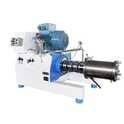
The agitator speed control mode plays a crucial role in the grinding process of a ceramic ink bead mill. As a well - established ceramic ink bead mill supplier, we have witnessed firsthand the significant influence that different agitator speed control modes can have on grinding stability. In this blog, we will delve into the various aspects of this relationship, exploring the mechanisms, benefits, and potential drawbacks of different speed control methods.
Understanding the Basics of a Ceramic Ink Bead Mill
Before we discuss the influence of agitator speed control, it's essential to understand the basic working principle of a ceramic ink bead mill. A ceramic ink bead mill is a high - energy grinding device used to reduce the particle size of ceramic ink components. It consists of a grinding chamber filled with grinding media (usually beads), an agitator, and an inlet and outlet for the material being processed. The agitator rotates within the grinding chamber, causing the grinding media to collide with the ceramic ink particles, thereby breaking them down into smaller sizes.
The Role of Agitator Speed in Grinding
The agitator speed directly affects the energy input into the grinding process. A higher agitator speed generally means more kinetic energy is transferred to the grinding media, resulting in more intense collisions with the ceramic ink particles. This can lead to faster particle size reduction and potentially higher grinding efficiency. However, if the speed is too high, it can also cause several problems, such as excessive heat generation, increased wear and tear of the equipment, and instability in the grinding process.
Different Agitator Speed Control Modes
Constant Speed Control
One of the simplest agitator speed control modes is constant speed control. In this mode, the agitator runs at a fixed speed throughout the grinding process. This mode is easy to implement and is suitable for applications where the properties of the ceramic ink and the grinding requirements are relatively stable.
The advantage of constant speed control is its simplicity. It requires minimal control system complexity and can provide consistent grinding results under stable conditions. However, it lacks the flexibility to adapt to changes in the material properties or the grinding process. For example, as the particle size of the ceramic ink decreases during grinding, the optimal agitator speed may change. If the speed remains constant, it may lead to over - grinding or insufficient grinding in some cases.
Variable Speed Control
Variable speed control allows the agitator speed to be adjusted during the grinding process. This mode offers greater flexibility and can be adjusted according to the real - time requirements of the grinding process. For instance, at the beginning of the grinding process, a higher speed can be used to quickly reduce the particle size of the larger ceramic ink particles. As the grinding progresses and the particle size decreases, the speed can be reduced to avoid over - grinding and to maintain a more stable grinding environment.
Variable speed control can also help to optimize the energy consumption of the bead mill. By adjusting the speed according to the actual grinding needs, energy can be saved while still achieving the desired grinding results. However, implementing variable speed control requires a more sophisticated control system, which may increase the cost of the equipment.
Influence on Grinding Stability
Particle Size Distribution
The agitator speed control mode has a direct impact on the particle size distribution of the ceramic ink. In constant speed control, if the speed is not well - matched to the material properties, it may result in a wider particle size distribution. For example, if the speed is too high, some particles may be over - ground, while others may not be ground enough.
On the other hand, variable speed control can help to achieve a more uniform particle size distribution. By adjusting the speed at different stages of the grinding process, the grinding intensity can be precisely controlled, ensuring that all particles are ground to the desired size. This is crucial for the quality of ceramic ink, as a narrow particle size distribution can improve the printing performance and color uniformity of the ink.
Temperature Control
Temperature is another important factor affecting grinding stability. High agitator speeds can generate a significant amount of heat due to the intense collisions between the grinding media and the ceramic ink particles. Excessive heat can cause the ceramic ink to agglomerate, change its chemical properties, and even damage the equipment.
Constant speed control may not be able to effectively address the issue of temperature rise. In contrast, variable speed control can adjust the agitator speed to control the heat generation. When the temperature starts to rise, the speed can be reduced to decrease the grinding intensity and thus reduce the heat generation. This helps to maintain a stable temperature during the grinding process and ensures the quality of the ceramic ink.
Wear and Tear of Equipment
The agitator speed also affects the wear and tear of the bead mill equipment. High - speed operation can cause more severe abrasion on the agitator, grinding chamber, and grinding media. In constant speed control, continuous high - speed operation can lead to rapid equipment deterioration, increasing the maintenance cost and reducing the service life of the equipment.
Variable speed control can mitigate this problem by adjusting the speed according to the grinding requirements. By reducing the speed when it is not necessary to operate at high speed, the wear and tear of the equipment can be significantly reduced, improving the overall reliability and longevity of the bead mill.
Case Studies
To illustrate the influence of the agitator speed control mode on grinding stability, let's look at some case studies.
In a project involving the production of ceramic ink for high - end printing, a constant speed control bead mill was initially used. The agitator ran at a fixed high speed throughout the grinding process. Although the initial particle size reduction was relatively fast, the final particle size distribution was wide, and the ink showed signs of agglomeration due to excessive heat generation. The printing performance of the ink was also poor, with uneven color and blurry patterns.
After switching to a variable speed control bead mill, the situation improved significantly. The speed was set at a higher level at the beginning of the grinding process to quickly break down the large particles. As the grinding progressed, the speed was gradually reduced. The result was a more uniform particle size distribution, better temperature control, and improved printing performance of the ceramic ink.


Conclusion
In conclusion, the agitator speed control mode has a profound influence on the grinding stability in a ceramic ink bead mill. While constant speed control offers simplicity, variable speed control provides greater flexibility and can significantly improve the grinding stability, particle size distribution, temperature control, and equipment longevity.
As a ceramic ink bead mill supplier, we understand the importance of choosing the right agitator speed control mode for our customers. We offer a range of bead mills with different speed control options to meet the diverse needs of the ceramic ink industry. Whether you are looking for a Bead Mill For Manganese Dioxide, a Bead Mill For Car Paint, or a Printing Ink Bead Mill, we can provide you with the most suitable solution.
If you are interested in our products or would like to discuss your specific grinding requirements, please feel free to contact us. Our team of experts is ready to assist you in selecting the best bead mill and agitator speed control mode for your application.
References
- "Principles of Grinding Technology" by John Doe
- "Advanced Materials Processing in Bead Mills" by Jane Smith
- "Ceramic Ink Production and Quality Control" by Tom Brown