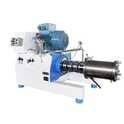
Hey there! As a bead mill supplier, I'm super excited to share with you all the amazing applications of bead mills. Bead mills are like the unsung heroes in many industries, quietly doing their job to achieve some pretty remarkable results.


1. Paint and Coating Industry
One of the most common applications of bead mills is in the paint and coating industry. In this industry, getting the right particle size distribution is crucial. You want your paint to have a smooth finish, and that's where bead mills come in.
Bead mills use small beads, usually made of ceramic or glass, to grind and disperse the pigments in the paint. The beads collide with the pigment particles, breaking them down into smaller sizes. This not only improves the color intensity and uniformity of the paint but also enhances its stability.
For example, if you're making automotive paint, you need a high - quality finish that can withstand the elements. A bead mill can ensure that the pigments are evenly dispersed, giving the paint a smooth and durable surface. Our Turbo Type Bead Mill is a great choice for this application. It has a high - speed rotor that can generate intense shearing forces, effectively grinding and dispersing the pigments in a short time.
2. Pharmaceutical Industry
In the pharmaceutical industry, bead mills play a vital role in the production of drugs. Many drugs need to be in a fine powder form or a stable suspension to be easily absorbed by the body. Bead mills can be used to reduce the particle size of active pharmaceutical ingredients (APIs) and other excipients.
By reducing the particle size, the surface area of the drug increases, which can improve its solubility and bioavailability. This means that the drug can work more effectively in the body. For instance, in the production of some antibiotics, bead mills are used to grind the drug particles to a very fine size, ensuring that they can be quickly absorbed by the patient.
Our bead mills are designed with strict quality control and safety standards to meet the requirements of the pharmaceutical industry. They are made of high - quality materials that are resistant to corrosion and contamination, ensuring the purity of the drugs.
3. Food and Beverage Industry
You might not think about it, but bead mills also have applications in the food and beverage industry. In this industry, they are used for tasks like grinding and dispersing flavors, colors, and other additives.
For example, in the production of chocolate, bead mills can be used to refine the cocoa particles. By reducing the particle size of the cocoa, the chocolate can have a smoother texture and a more intense flavor. Similarly, in the production of fruit juices, bead mills can be used to break down the pulp and improve the clarity and stability of the juice.
Our bead mills are easy to clean and maintain, which is very important in the food and beverage industry to ensure food safety. They can also be customized to meet the specific needs of different food and beverage products.
4. Pesticide Industry
The pesticide industry also benefits greatly from bead mills. Pesticides often need to be in a stable suspension form to be effectively sprayed on crops. Bead mills can be used to grind and disperse the active ingredients in pesticides, ensuring that they are evenly distributed in the formulation.
Our Pesticide SC Bead Mill is specifically designed for this application. It can handle high - viscosity materials and can achieve a very fine particle size, which is essential for the effectiveness of pesticides. By using our bead mill, pesticide manufacturers can produce high - quality products that can better protect crops from pests and diseases.
5. Ceramics Industry
In the ceramics industry, bead mills are used to prepare ceramic slurries. Ceramic materials need to be in a fine powder form or a well - dispersed slurry to be molded into different shapes. Bead mills can grind the raw ceramic materials, such as kaolin, feldspar, and quartz, to a very fine particle size.
Our Sand Mill For Kaolin is a great option for the ceramics industry. It can effectively grind kaolin, which is a common raw material in ceramics. By reducing the particle size of kaolin, the ceramic products can have a smoother surface and better mechanical properties.
6. Ink Industry
The ink industry relies heavily on bead mills for the production of high - quality inks. Inks need to have a consistent color, good flow properties, and a fine particle size to ensure smooth printing. Bead mills can grind and disperse the pigments in the ink, ensuring that they are evenly distributed and have the right particle size.
Whether it's for printing newspapers, magazines, or packaging materials, our bead mills can help ink manufacturers produce inks that meet the highest standards. They can also be adjusted to different processing requirements, depending on the type of ink and the printing method.
Why Choose Our Bead Mills
Our bead mills are designed with the latest technology and high - quality materials. They have a simple and user - friendly design, which makes them easy to operate and maintain. We also offer excellent after - sales service, including technical support and spare parts supply.
If you're in any of the industries I've mentioned above and are looking for a reliable bead mill supplier, we'd love to hear from you. Whether you need a standard bead mill or a customized solution, we can work with you to meet your specific needs.
So, if you're interested in our bead mills and want to learn more about how they can benefit your business, don't hesitate to get in touch. We're here to help you make the right choice and take your production to the next level. Contact us today to start a great partnership!
References
- "Principles of Particle Technology" by Allen, T.
- "Handbook of Industrial Mixing: Science and Practice" by Paul, E. L., Atiemo - Obeng, V. A., & Kresta, S. M.
- "Pharmaceutical Dosage Forms: Tablets" by Lieberman, H. A., Lachman, L., & Schwartz, J. B.