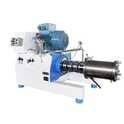
In the realm of industrial processing, the demand for efficient and precise grinding equipment is ever - present. One such machine that has gained significant attention is the Turbo Type Bead Mill. As a supplier of Turbo Type Bead Mills, I often receive inquiries about its applicability in various industries and for different materials. A question that frequently comes up is: Can the Turbo Type Bead Mill be used for grinding rubber materials? In this blog post, we will delve into this topic to provide a comprehensive answer.
Understanding the Turbo Type Bead Mill
Before we discuss its use with rubber materials, let's first understand what a Turbo Type Bead Mill is. A Turbo Type Bead Mill is a high - energy milling device that uses beads (usually made of ceramic, glass, or zirconia) as grinding media. The mill operates by rotating a shaft with discs or pins at high speed, which agitates the beads and the material to be ground. This agitation causes the beads to collide with the material particles, breaking them down into smaller sizes through shear and impact forces.
The key advantages of a Turbo Type Bead Mill include its high grinding efficiency, ability to achieve very fine particle sizes, and its suitability for a wide range of viscosities. These features make it a popular choice in industries such as Bead Mill For Pharmaceutical, Bead Mill for Cell Disruption, and Sand Mill For Ink.
Characteristics of Rubber Materials
Rubber is a unique material with distinct physical and chemical properties. It is elastic, which means it can deform under stress and return to its original shape. This elasticity is due to the long - chain polymer structure of rubber molecules. Additionally, rubber can have a wide range of viscosities depending on its formulation, processing conditions, and the presence of additives.
There are different types of rubber, including natural rubber and synthetic rubbers such as styrene - butadiene rubber (SBR), nitrile rubber (NBR), and silicone rubber. Each type has its own set of properties, which can influence the grinding process.


Feasibility of Using Turbo Type Bead Mill for Grinding Rubber Materials
Advantages
- Particle Size Reduction: One of the primary goals in grinding rubber materials is to reduce the particle size. The Turbo Type Bead Mill's high - energy agitation can effectively break down rubber particles. The intense shear and impact forces generated by the rotating discs or pins and the beads can break the long - chain polymer structures of rubber, resulting in smaller particle sizes. This is crucial for applications where fine rubber particles are required, such as in the production of rubber additives or in the blending of rubber with other materials.
- Homogeneous Mixing: In many rubber processing applications, it is necessary to mix rubber with various additives such as fillers, plasticizers, and curing agents. The Turbo Type Bead Mill can not only grind the rubber but also ensure a homogeneous distribution of these additives. The continuous agitation of the beads and the material helps to disperse the additives evenly throughout the rubber matrix, improving the overall quality and performance of the final rubber product.
- Versatility: As mentioned earlier, the Turbo Type Bead Mill can handle a wide range of viscosities. Rubber materials can have different viscosities depending on their type and processing state. Whether it is a low - viscosity rubber solution or a high - viscosity rubber compound, the Turbo Type Bead Mill can be adjusted to operate effectively. This versatility makes it a suitable choice for different rubber processing scenarios.
Challenges
- Heat Generation: Rubber is sensitive to heat. The high - energy operation of the Turbo Type Bead Mill can generate a significant amount of heat during the grinding process. Excessive heat can cause the rubber to degrade, cross - link prematurely, or lose its elasticity. To overcome this challenge, proper cooling systems need to be installed in the mill. For example, a water - cooling jacket can be used to dissipate the heat generated during grinding, ensuring that the rubber material remains within its optimal processing temperature range.
- Bead Wear: Rubber is a relatively soft material compared to some of the other materials typically processed in a bead mill. However, the continuous abrasion between the rubber and the beads can still cause wear on the beads. This not only affects the grinding efficiency but also increases the cost of operation as the beads need to be replaced more frequently. To minimize bead wear, it is important to select the appropriate type and size of beads. Harder beads, such as zirconia beads, may be more suitable for grinding rubber materials as they are more resistant to wear.
- Clogging: Rubber has a tendency to stick to surfaces. During the grinding process, rubber particles may adhere to the internal components of the mill, such as the discs, pins, and the beads. This can lead to clogging, which reduces the flow of the material through the mill and affects the overall grinding performance. Regular cleaning and maintenance of the mill are essential to prevent clogging. Additionally, the use of appropriate dispersants or anti - sticking agents can help to reduce the adhesion of rubber particles to the mill components.
Case Studies and Applications
There are several industries where the Turbo Type Bead Mill has been successfully used for grinding rubber materials.
- Rubber Recycling: In the rubber recycling industry, the goal is to break down waste rubber into smaller particles so that it can be reused. The Turbo Type Bead Mill can be used to grind waste rubber tires or other rubber products into fine powder. This powder can then be used as a filler in new rubber products or in other applications such as asphalt modification.
- Rubber Additive Production: Many rubber additives, such as carbon black - rubber masterbatches, require fine particle sizes and homogeneous mixing. The Turbo Type Bead Mill can effectively grind the rubber and disperse the additives to produce high - quality rubber additives. These additives can improve the mechanical properties, such as strength and abrasion resistance, of the final rubber products.
Considerations for Using Turbo Type Bead Mill with Rubber Materials
When using a Turbo Type Bead Mill for grinding rubber materials, the following considerations should be taken into account:
- Mill Design: The design of the Turbo Type Bead Mill should be optimized for rubber grinding. This includes the selection of appropriate disc or pin configurations, the size and shape of the grinding chamber, and the flow path of the material. A well - designed mill can improve the grinding efficiency and reduce the risk of clogging and heat generation.
- Bead Selection: As mentioned earlier, the type and size of beads are crucial. The beads should be hard enough to break down the rubber particles but also resistant to wear. The size of the beads should be selected based on the desired particle size of the rubber and the viscosity of the material.
- Process Parameters: The operating parameters of the mill, such as the rotational speed, the flow rate of the material, and the bead loading, need to be carefully adjusted. These parameters can significantly affect the grinding efficiency, particle size distribution, and the quality of the final rubber product.
Conclusion
In conclusion, the Turbo Type Bead Mill can be used for grinding rubber materials, but it comes with both advantages and challenges. With proper design, bead selection, and process control, the Turbo Type Bead Mill can effectively reduce the particle size of rubber, ensure homogeneous mixing, and improve the overall quality of rubber products. However, it is important to address the challenges such as heat generation, bead wear, and clogging to ensure the long - term and efficient operation of the mill.
If you are involved in the rubber processing industry and are looking for a reliable grinding solution, our Turbo Type Bead Mills offer a viable option. We have extensive experience in providing customized grinding solutions for different industries, including rubber processing. Our team of experts can work with you to understand your specific requirements and recommend the most suitable mill configuration and operating parameters. Contact us to discuss your needs and explore how our Turbo Type Bead Mills can enhance your rubber processing operations.
References
- "Rubber Technology" by Maurice Morton.
- "Industrial Mixing: Science and Practice" by Edward L. Paul, Victor A. Atiemo - Obeng, and Suzanne M. Kresta.
- Technical literature on Turbo Type Bead Mills from various manufacturers.