A reactor is a crucial piece of equipment in various industries, including chemical, pharmaceutical, food, and environmental engineering. As a leading supplier of Reactor & Vessels, I'm often asked about the working principles of reactors. In this blog, I'll delve into the fundamental concepts behind how reactors operate and their significance in industrial processes.
Basic Definition of a Reactor
A reactor is a device designed to facilitate chemical reactions. It provides a controlled environment where reactants can come into contact with each other under specific conditions of temperature, pressure, and agitation. The goal of a reactor is to convert reactants into desired products efficiently and safely. The performance of a reactor is often evaluated based on factors such as reaction rate, selectivity, and yield.
Types of Reactors and Their Working Principles
Batch Reactors
Batch reactors are one of the simplest types of reactors. In a batch reactor, all the reactants are added to the reactor at the beginning of the process. The reactor is then sealed, and the reaction proceeds over a period of time. Once the reaction is complete, the products are removed from the reactor.


The working principle of a batch reactor is based on the concept of a closed - system reaction. Since no reactants are added or products removed during the reaction, the concentration of reactants decreases over time, and the concentration of products increases. The reaction rate in a batch reactor is highly dependent on the initial concentrations of the reactants, temperature, and the presence of catalysts. Batch reactors are suitable for small - scale production, research and development, and the production of specialty chemicals where flexibility and product quality control are essential.
Mixing Reactor is a type of batch reactor that emphasizes the importance of proper mixing. In a mixing reactor, internal agitation mechanisms ensure that the reactants are uniformly distributed throughout the reactor volume. This helps to increase the reaction rate by enhancing the contact between reactants and, in some cases, the catalysts.
Continuous Reactors
Continuous reactors, on the other hand, operate on a continuous - flow basis. Reactants are continuously fed into the reactor, and products are continuously removed. This allows for a steady - state operation, where the concentrations of reactants and products at any point in the reactor remain constant over time.
There are several types of continuous reactors, such as plug - flow reactors (PFR) and continuous - stirred tank reactors (CSTR).
Plug - Flow Reactors (PFR)
In a PFR, the reactants flow through the reactor in a plug - like manner. This means that there is no axial mixing of the fluid in the direction of flow. Each "plug" of fluid moves through the reactor independently, and the reaction proceeds as the plug moves along the reactor length. The reaction rate in a PFR varies along the length of the reactor because the concentration of reactants decreases as the reaction progresses. PFRs are often used for reactions that are highly exothermic or endothermic because the ability to control the reaction conditions along the reactor length allows for better temperature control.
Continuous - Stirred Tank Reactors (CSTR)
A CSTR is a well - mixed reactor. The reactants are continuously added to the reactor, and the contents of the reactor are vigorously stirred to ensure uniform composition throughout. The reaction rate in a CSTR is determined by the average concentration of reactants in the reactor. Since the contents are well - mixed, the outlet concentration of the products is the same as the concentration inside the reactor. CSTRs are commonly used for reactions that are not too sensitive to the initial reactant concentrations and for reactions that require a high degree of mixing.
Factors Affecting Reactor Operation
Temperature
Temperature has a profound effect on the reaction rate. According to the Arrhenius equation, the reaction rate constant (k) increases exponentially with increasing temperature. In general, a higher temperature leads to a higher reaction rate because more reactant molecules have sufficient energy to overcome the activation energy barrier. However, increasing the temperature also has some drawbacks. For exothermic reactions, a high temperature may lead to thermal runaway, where the reaction rate becomes uncontrollably high. In addition, high temperatures can cause side reactions and degradation of products.
Pressure
Pressure affects the reaction mainly by influencing the concentration of gaseous reactants. According to the ideal gas law (PV = nRT), an increase in pressure at a constant temperature and volume leads to an increase in the number of moles of gas per unit volume, which is equivalent to an increase in concentration. For reactions involving gases, increasing the pressure can increase the reaction rate. However, high - pressure operation also requires special reactor designs and safety precautions.
Catalysts
Catalysts are substances that increase the reaction rate without being consumed in the reaction. They work by providing an alternative reaction pathway with a lower activation energy. Catalysts can significantly increase the efficiency of a reactor by reducing the energy required for the reaction to occur. There are different types of catalysts, such as homogeneous catalysts (which are in the same phase as the reactants) and heterogeneous catalysts (which are in a different phase from the reactants).
Role of Reactor Design in Industrial Processes
The design of a reactor is crucial for achieving optimal performance in industrial processes. Reactor design involves considerations such as reactor type selection, sizing, and the design of internal components.
The choice of reactor type depends on various factors, including the nature of the reaction (e.g., exothermic or endothermic, batch or continuous), the reaction rate, and the desired product quality. For example, if a reaction requires a long residence time and a high degree of mixing, a CSTR may be a better choice. If the reaction is fast and requires precise control of reaction conditions, a PFR might be more suitable.
Sizing the reactor is also important. The reactor volume needs to be large enough to accommodate the reactants and allow the reaction to proceed to the desired extent. However, an oversized reactor can be costly in terms of capital investment and operating costs.
Internal components, such as agitators, heat exchangers, and baffles, play an important role in reactor operation. Agitators are used to mix the reactants and ensure uniform distribution of temperature and concentration. Heat exchangers are used to control the temperature of the reaction by adding or removing heat. Baffles are used to enhance mixing and prevent the formation of stagnant regions in the reactor.
Movable Tank and Vessel in Reactor Systems
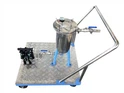
Movable tanks and vessels are important components in reactor systems. They can be used for storage of reactants or products, as well as for intermediate processing steps. Movable tanks and vessels offer flexibility in terms of operation and maintenance. They can be easily moved to different locations within a plant, allowing for efficient use of space and resources.
Conclusion
Understanding the working principle of a reactor is essential for the efficient and safe operation of industrial processes. Whether it's a batch reactor for small - scale specialty chemical production or a continuous reactor for large - scale commodity chemical manufacturing, the right choice of reactor and proper design can make a significant difference in product quality and production efficiency.
As a reputable supplier of Reactor & Vessels, we are committed to providing high - quality reactors that are designed to meet the specific needs of our customers. Whether you are looking for a standard reactor or a custom - designed solution, we have the expertise and experience to help you.
If you are interested in purchasing reactors or vessels for your industrial processes, we invite you to contact us for detailed information and procurement discussions. Our team of experts will be delighted to assist you in selecting the most suitable equipment for your application.
References
- Levenspiel, O. (1999). Chemical Reaction Engineering (3rd ed.). Wiley.
- Fogler, H. S. (2016). Elements of Chemical Reaction Engineering (5th ed.). Prentice Hall.