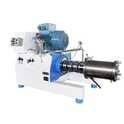
When it comes to the world of dyes pigment manufacturing, the bead mill is an indispensable tool. But an often - debated topic among professionals in the industry is: what is the optimal bead size for a Dyes Pigment Bead Mill? As a leading supplier of Dyes Pigment Bead Mills, we've delved deep into this question to provide you with both scientific insights and practical advice.
The Role of Bead Size in a Dyes Pigment Bead Mill
The bead size in a bead mill has a profound impact on the milling process. Smaller beads typically offer a larger surface area per unit volume. This increased surface area allows for more contact between the beads and the dyes pigment, leading to a more efficient grinding and dispersion process. For instance, if you're dealing with a high - end, fine - granulated dyes pigment that requires a very small particle size in the final product, smaller beads can be extremely effective. They can break down the large pigment particles into tinier, more uniform sizes, resulting in a better - quality end product with enhanced color intensity and dispersion stability.
On the other hand, larger beads have their own advantages. They possess greater mass and inertia. When it comes to coarse - grained dyes pigments or when you need to perform initial pre - grinding, larger beads can deliver more powerful impacts. This helps in reducing the large chunks of pigments into smaller pieces more quickly, which can then be further refined by smaller beads in subsequent milling stages.
Factors Influencing the Optimal Bead Size
Pigment Characteristics
The nature of the dyes pigment itself is a crucial factor. Different pigments have different hardness, particle size distribution, and chemical properties. Harder pigments, such as some inorganic pigments, may require larger beads to initiate the grinding process. For example, titanium dioxide, a common white pigment used in many industries, is relatively hard. Using larger beads (around 1 - 3 mm in diameter) in the initial milling can help break down its large particles more effectively.
In contrast, organic dyes pigments are generally softer and more delicate. For these, smaller beads (0.1 - 1 mm in diameter) are often preferred. They can achieve the desired particle size reduction without causing excessive heat generation or chemical degradation of the pigment.
Desired Particle Size and Distribution
The final particle size and its distribution in the dyes pigment are key considerations. If you need a very narrow particle size distribution, smaller beads are usually the way to go. They can provide a more precise and consistent grinding action, resulting in a product with particles that are more uniform in size. For applications where a specific particle size range is critical, such as in high - end printing inks or automotive coatings, using the right bead size can make a significant difference in the performance of the final product.
Milling Efficiency
Milling efficiency is another aspect to take into account. The bead size affects the flow rate and energy consumption during the milling process. Smaller beads may require more time to achieve the desired grinding effect due to their lower impact energy, but they can offer better dispersion. Larger beads, while capable of rapid initial grinding, may not provide the same level of fine - tuning in terms of particle size reduction. Therefore, finding the right balance between bead size and milling time is essential for optimizing efficiency.
Case Studies: Optimal Bead Sizes in Different Applications
Textile Dyes Pigments
In the textile industry, dyes pigments need to have excellent color fastness and dispersion in the fabric. For most textile dyes, a bead size in the range of 0.2 - 0.8 mm is often optimal. This size allows for a good balance between particle size reduction and dispersion, ensuring that the pigment can penetrate the textile fibers evenly and provide long - lasting color.
Cosmetic Dyes Pigments
Cosmetic products demand the highest level of quality and safety. The dyes pigments used in cosmetics need to be extremely fine and well - dispersed. In this case, very small beads, typically in the range of 0.1 - 0.3 mm, are used. These small beads can achieve the required particle size for a smooth and homogeneous texture in the cosmetic products, while also minimizing the risk of irritation to the skin.
Industrial Coatings Dyes Pigments
Industrial coatings require pigments that can provide good coverage, durability, and resistance to environmental factors. For these applications, a combination of bead sizes may be used. Larger beads (1 - 2 mm) can be used in the initial stage to break down the large pigment aggregates, followed by smaller beads (0.5 - 1 mm) for further refinement and dispersion. This two - stage approach helps to achieve the desired particle size and distribution for high - performance industrial coatings.
Our Product Range and the Right Bead Size Selection
As a Dyes Pigment Bead Mill supplier, we offer a variety of bead mills suitable for different bead sizes. Our Bead Mill For Insecticide is designed with flexibility in mind, allowing you to use different bead sizes depending on the specific requirements of your insecticide dyes pigment production. Similarly, our Bead Mill For Ceramic Pigment is optimized for the unique needs of ceramic pigment processing, where the choice of bead size can significantly impact the color and texture of the final ceramic product.
We also have a range of Sand Mill, which is another type of milling equipment commonly used in the dyes pigment industry. Sand mills can be used with different bead sizes, and we can provide guidance on the best selection based on your application.
Conclusion and Contact for Purchasing
In conclusion, determining the optimal bead size for a Dyes Pigment Bead Mill is a complex but crucial process. It depends on various factors such as pigment characteristics, desired particle size, and milling efficiency. By understanding these factors and choosing the right bead size, you can improve the quality of your dyes pigment products, enhance milling efficiency, and ultimately boost your business performance.


If you are interested in our Dyes Pigment Bead Mill products or need more information on bead size selection for your specific application, we encourage you to reach out to us. Our team of experts is ready to assist you in making the best decision for your production needs.
References
- "Handbook of Industrial Mixing: Science and Practice", Edited by Edward L. Paul, Victor A. Atiemo - Obeng, Suzanne M. Kresta.
- "Particle Size Reduction Technology", by K. K. S. Upadhyay.