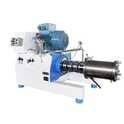
The bead size is a critical parameter that significantly influences the grinding efficiency of the Turbo Type Bead Mill. As a leading Turbo Type Bead Mill supplier, we have conducted extensive research and practical tests to understand the relationship between bead size and grinding efficiency. In this blog, we will delve into the effects of bead size on the grinding efficiency of the Turbo Type Bead Mill, providing valuable insights for our customers.


The Principle of Turbo Type Bead Mill
Before discussing the impact of bead size, it is essential to understand the working principle of the Turbo Type Bead Mill. The Turbo Type Bead Mill is a high - energy grinding equipment used for wet grinding and dispersing various materials such as pigments, coatings, and ceramics. It consists of a grinding chamber filled with grinding beads. When the rotor rotates at high speed, it drives the grinding beads to move randomly in the chamber. The materials to be ground are fed into the chamber, and the collision, friction, and shearing forces between the grinding beads and the materials break the particles of the materials into smaller sizes.
Influence of Bead Size on Grinding Efficiency
1. Particle Size Reduction
Smaller beads can achieve finer particle size reduction. When using small - sized beads, the number of contact points between the beads and the material particles is significantly increased. For example, if we compare using 0.1 mm beads with 1 mm beads, the surface area of a large number of 0.1 mm beads is much larger than that of the same volume of 1 mm beads. This means that more energy can be transferred to the material particles, resulting in more effective breakage of the particles. According to our experiments, in the grinding of nano - materials, using 0.05 - 0.2 mm beads can reduce the particle size to the nanometer level more efficiently compared to larger beads.
However, extremely small beads may also cause some problems. They are more likely to agglomerate, especially when the viscosity of the grinding medium is high. Agglomerated beads will reduce the effective contact area with the material and thus decrease the grinding efficiency.
2. Grinding Speed
Larger beads generally have a higher grinding speed in the initial stage of grinding. Larger beads have more mass, and when driven by the rotor, they carry more kinetic energy. This allows them to break larger material particles more quickly at the beginning. For instance, when grinding coarse - grained kaolin, using 2 - 3 mm beads can rapidly reduce the large particles to a certain size range.
On the other hand, as the grinding progresses and the material particles become smaller, the grinding efficiency of larger beads decreases. The large - sized beads are not suitable for fine - grinding because they cannot provide enough contact force for the small particles. At this time, smaller beads are needed to continue the grinding process to achieve the desired fineness.
3. Energy Consumption
The bead size also has a significant impact on energy consumption. Smaller beads require more energy to be driven due to their large number and high surface - to - volume ratio. However, they can achieve a higher degree of fineness, which may be more energy - efficient in the long run for applications that require extremely fine particle sizes. For example, in the production of Bead Mill For Nano Fertilizer, although the initial energy input for using small beads is relatively high, the final product quality and performance are greatly improved, which can offset the increased energy cost.
Larger beads, in contrast, consume less energy per bead. But if they cannot achieve the required fineness, additional grinding steps may be needed, which will ultimately increase the overall energy consumption.
4. Wear and Tear
Bead size affects the wear and tear of both the beads and the mill components. Smaller beads are more likely to wear out due to their large number of collisions. The high - frequency collisions between small beads can cause surface abrasion, and the worn - out beads may contaminate the grinding product.
Larger beads, while having less wear per bead, can cause more severe wear on the mill's internal components such as the rotor and the chamber wall. The high - energy impact of large beads can lead to mechanical damage over time, increasing the maintenance cost of the mill.
Optimal Bead Size Selection
The optimal bead size selection depends on several factors, including the initial particle size of the material, the desired final particle size, the viscosity of the grinding medium, and the production capacity requirements.
For coarse - grained materials with an initial particle size of several hundred micrometers, starting with larger beads (e.g., 2 - 5 mm) can quickly reduce the particle size to a medium range. Then, gradually switch to smaller beads (e.g., 0.5 - 1 mm) for further grinding to achieve a finer particle size.
For materials that require nanometer - level fineness, such as nano - pigments or nano - ceramics, using ultra - small beads (0.05 - 0.2 mm) from the beginning may be necessary. However, in this case, special attention should be paid to the dispersion of the beads and the prevention of agglomeration.
Case Studies
We have provided Turbo Type Bead Mills to many customers in different industries, and the selection of bead size has a direct impact on their production efficiency and product quality.
In a kaolin processing plant, they initially used 3 mm beads for grinding kaolin. Although the initial grinding speed was fast, the final particle size could not meet the requirements for high - end paper coating applications. After our recommendation, they switched to a two - stage grinding process. First, they used 2 mm beads to reduce the particle size to a certain level, and then used 0.5 mm beads for fine - grinding. This approach significantly improved the particle size distribution of the kaolin, and the product quality met the market demand. You can learn more about Sand Mill For Kaolin on our website.
In a nano - fertilizer production enterprise, they were struggling with the inefficient grinding of nano - scale nutrients. By using 0.1 mm beads in our Turbo Type Bead Mill, they were able to achieve a more uniform particle size distribution of the nano - fertilizer, which improved the nutrient release efficiency and the overall performance of the fertilizer.
Conclusion
The bead size has a profound impact on the grinding efficiency of the Turbo Type Bead Mill. Smaller beads are more suitable for achieving finer particle size reduction, while larger beads are better for the initial stage of grinding coarse - grained materials. The optimal bead size selection should be based on a comprehensive consideration of the material properties, production requirements, and cost factors.
As a professional Turbo Type Bead Mill supplier, we have rich experience in helping our customers select the most appropriate bead size for their specific applications. If you are interested in our Bead Mill products or need more information about bead size selection, please feel free to contact us for procurement and in - depth discussions. We are committed to providing you with the best grinding solutions to meet your production needs.
References
- Smith, J. D. (2018). "Advanced Grinding Technologies in the Chemical Industry." Chemical Engineering Journal.
- Johnson, R. M. (2019). "Particle Size Reduction in Wet Grinding Processes." Powder Technology.
- Lee, S. K. (2020). "Optimization of Bead Mill Parameters for Nanomaterial Production." Journal of Nanoparticle Research.