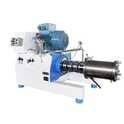
The pharmaceutical industry is a highly regulated and quality - conscious sector where precision and safety are of utmost importance. When it comes to particle size reduction and dispersion processes, bead mills have emerged as a crucial piece of equipment. As a bead mill supplier, I understand the unique requirements that the pharmaceutical industry has for using bead mills. In this blog, I will delve into these requirements in detail.
1. Material Compatibility
One of the primary requirements for using a bead mill in the pharmaceutical industry is material compatibility. The mill's components, such as the grinding chamber, agitator, and seals, must be made of materials that do not contaminate the pharmaceutical products. Stainless steel, particularly high - grade stainless steel like 316L, is a popular choice due to its corrosion resistance and inertness. It can withstand the harsh chemical environments often encountered in pharmaceutical manufacturing without leaching any harmful substances into the product.
Ceramics are also used in some parts of the bead mill, especially for the grinding media and liners. Alumina and zirconia ceramics are preferred because they are wear - resistant and have low reactivity with pharmaceutical substances. For example, zirconia beads are commonly used as grinding media in bead mills for pharmaceutical applications. They offer high density, which results in efficient grinding, and are chemically stable, ensuring that they do not introduce any impurities into the product.


2. Sterility and Cleanability
Sterility is a non - negotiable requirement in the pharmaceutical industry. Bead mills must be designed to be easily cleaned and sterilized to prevent cross - contamination between different batches of pharmaceutical products. The internal surfaces of the mill should be smooth and free of crevices where bacteria and other microorganisms can accumulate.
Many bead mills in the pharmaceutical industry are equipped with clean - in - place (CIP) and sterilize - in - place (SIP) systems. CIP systems use automated cleaning solutions to flush out the mill, removing any residual product and contaminants. SIP systems, on the other hand, use steam or other sterilizing agents to kill any remaining microorganisms. These systems not only ensure the sterility of the mill but also reduce the time and labor required for manual cleaning and sterilization.
3. Particle Size Control
Precise particle size control is essential in pharmaceutical manufacturing. The particle size of the active pharmaceutical ingredient (API) can significantly affect the drug's bioavailability, solubility, and stability. Bead mills need to be capable of producing particles within a narrow size distribution range.
Modern bead mills use advanced control systems to regulate the grinding process. Parameters such as agitator speed, bead size, and residence time can be adjusted to achieve the desired particle size. For example, reducing the bead size can result in finer particle grinding, while increasing the agitator speed can enhance the grinding efficiency. Real - time monitoring of particle size during the grinding process is also possible with the use of in - line particle size analyzers. These analyzers provide instant feedback, allowing operators to make adjustments to the mill's operating parameters as needed.
4. Containment and Safety
Pharmaceutical products often contain potent and potentially hazardous substances. Therefore, bead mills must be designed with proper containment features to protect operators and the environment. The mill should be enclosed to prevent the release of dust and aerosols during the grinding process.
Safety features such as interlocks and emergency stop buttons are also required. Interlocks ensure that the mill cannot be opened while it is in operation, preventing accidental contact with the moving parts and the product. Emergency stop buttons allow operators to quickly shut down the mill in case of an emergency.
5. Validation and Documentation
In the pharmaceutical industry, all equipment must be validated to ensure that it meets the required quality standards. Bead mills need to undergo a validation process that includes installation qualification (IQ), operational qualification (OQ), and performance qualification (PQ).
IQ verifies that the mill is installed correctly according to the manufacturer's specifications. OQ tests the mill's operating parameters to ensure that it functions as intended. PQ demonstrates that the mill can consistently produce products that meet the predefined quality criteria.
Comprehensive documentation is also required throughout the validation process. This documentation includes installation manuals, operating procedures, maintenance records, and validation reports. The documentation serves as evidence that the bead mill has been properly installed, operated, and maintained, and that it is capable of producing high - quality pharmaceutical products.
6. Regulatory Compliance
The pharmaceutical industry is subject to strict regulations from various regulatory bodies such as the Food and Drug Administration (FDA) in the United States and the European Medicines Agency (EMA) in Europe. Bead mills must comply with these regulations to be used in pharmaceutical manufacturing.
Regulatory requirements cover aspects such as design, construction, operation, and documentation of the equipment. For example, the mill must be designed in accordance with good manufacturing practice (GMP) guidelines. GMP ensures that the pharmaceutical products are consistently produced and controlled to the quality standards appropriate for their intended use.
7. Customization and Flexibility
Pharmaceutical manufacturers often have unique requirements based on the specific products they are producing. Bead mills need to be customizable to meet these diverse needs. For example, some pharmaceutical products may require a different type of grinding chamber or agitator design to achieve the desired grinding results.
Flexibility in terms of processing capacity is also important. Bead mills should be able to handle different batch sizes, from small - scale research and development batches to large - scale production batches. This allows pharmaceutical manufacturers to use the same mill throughout the product development and production lifecycle.
8. Energy Efficiency
In today's environmentally conscious world, energy efficiency is an important consideration. Bead mills should be designed to consume less energy while still maintaining high - performance grinding. Advanced motor technologies and optimized mill designs can help reduce energy consumption.
For example, some bead mills use variable frequency drives (VFDs) to control the speed of the agitator motor. VFDs allow the motor to operate at the most energy - efficient speed, depending on the grinding requirements. This not only reduces energy costs but also minimizes the environmental impact of the pharmaceutical manufacturing process.
Conclusion
The requirements for using a bead mill in the pharmaceutical industry are stringent and multifaceted. From material compatibility and sterility to particle size control and regulatory compliance, every aspect of the mill's design and operation must be carefully considered. As a bead mill supplier, we are committed to providing high - quality bead mills that meet all these requirements.
If you are in the pharmaceutical industry and are looking for a reliable bead mill for your manufacturing processes, we invite you to [contact us for a consultation]. We can help you select the right bead mill for your specific needs and provide you with the necessary support for installation, validation, and maintenance.
For more information about our bead mills, you can visit our website:
References
- Pharmaceutical Engineering: A Complete Guide to Design, Construction, and Operation. Wiley.
- Good Manufacturing Practice (GMP) Guidelines for Pharmaceutical Products. FDA.
- Particle Size Analysis in Pharmaceutical Manufacturing. Journal of Pharmaceutical Sciences.