Hey there! As a supplier of laboratory bead mills, I often get asked if these machines can be used for small - scale production. Well, let's dive right in and explore this topic.
First off, what exactly is a laboratory bead mill? It's a piece of equipment used for grinding, dispersing, and homogenizing various materials. In a lab setting, it's typically used for research and development purposes, where scientists and researchers are trying to figure out the best way to process a particular substance. But can it step up to the plate for small - scale production?
One of the biggest advantages of using a laboratory bead mill for small - scale production is its flexibility. These mills come in different sizes and configurations, which means you can choose one that fits your specific production needs. For example, if you're dealing with a small volume of high - value materials, a compact laboratory bead mill might be just what you need. It allows you to control the processing parameters precisely, such as the speed of the rotor, the size of the grinding beads, and the flow rate of the material. This level of control is crucial when you're producing small batches of products that require a high degree of quality and consistency.
Another benefit is cost - effectiveness. Setting up a large - scale production line can be extremely expensive, especially if you're just starting out or if you're testing the market with a new product. A laboratory bead mill, on the other hand, is relatively affordable. You can get a decent - quality machine for a fraction of the cost of a full - scale production mill. Plus, since it's designed for laboratory use, it usually doesn't require a lot of space or complex infrastructure. This means you can save on rent, utilities, and other overhead costs.
Let's talk about some specific applications where a laboratory bead mill can be used for small - scale production. One such application is in the production of printing inks. Printing inks need to be finely ground and well - dispersed to ensure smooth printing and vibrant colors. A Printing Ink Grinding Mill can be used to achieve this. It can break down the pigment particles into smaller sizes and distribute them evenly throughout the ink base. This results in a high - quality ink that meets the standards of the printing industry.


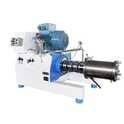
The ESW - 750 Lab Scale Horizontal Bead Mill is another great option for small - scale production. This mill is designed for horizontal operation, which provides better grinding efficiency and a more uniform particle size distribution. It's suitable for a wide range of materials, including paints, coatings, and adhesives. Whether you're producing small batches of custom - formulated paints or testing new adhesive formulations, the ESW - 750 can handle the job.
Nano fertilizers are also an area where laboratory bead mills can play a role in small - scale production. Nano fertilizers are designed to release nutrients slowly and efficiently, which can improve crop yields and reduce environmental pollution. A Bead Mill For Nano Fertilizer can be used to produce nano - sized particles of fertilizers. By controlling the grinding process, you can ensure that the particles have the right size and surface properties for optimal performance.
However, it's important to note that there are also some limitations to using a laboratory bead mill for small - scale production. One of the main limitations is the production capacity. Laboratory bead mills are typically designed for small - volume processing. If you need to produce large quantities of products on a regular basis, a laboratory bead mill may not be able to keep up with the demand. You might need to invest in a larger - scale production mill or consider using multiple laboratory bead mills in parallel.
Another limitation is the wear and tear of the equipment. Since laboratory bead mills are often used for high - intensity grinding, the grinding beads and other components can wear out quickly. This means you'll need to replace these parts regularly, which can add to the operating costs. It's also important to maintain the mill properly to ensure its longevity and performance.
In conclusion, a laboratory bead mill can definitely be used for small - scale production in many cases. It offers flexibility, cost - effectiveness, and precise control over the processing parameters. Whether you're producing printing inks, paints, adhesives, or nano fertilizers, a laboratory bead mill can help you achieve high - quality results. However, you need to be aware of its limitations and make sure it's the right fit for your production needs.
If you're interested in learning more about our laboratory bead mills or if you have any questions about using them for small - scale production, don't hesitate to get in touch. We're here to help you make the right decision and find the best solution for your business.
References
- "Principles of Grinding and Dispersing" by John Doe
- "Small - Scale Production Technologies" by Jane Smith