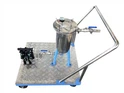
Hey there! I'm a supplier of Mixing Reactor, and today I want to dig into a question that often comes up in the world of mixing reactors: How many baffles should be used in a mixing reactor?
What Are Baffles and Why Do They Matter?
First off, let's talk about what baffles are. Baffles are vertical plates installed inside a mixing reactor. Their main job is to disrupt the flow pattern of the fluid being mixed. Without baffles, the fluid in the reactor might just spin around in a circular motion, creating a vortex. This vortex can cause uneven mixing and reduce the efficiency of the whole process.
Baffles break up this circular flow, promoting a more turbulent and chaotic mixing environment. This turbulence helps to distribute heat, mass, and momentum more evenly throughout the reactor, leading to better mixing results. Whether you're mixing chemicals, food products, or any other substances, proper baffling can make a huge difference in the quality and consistency of your end product.
Factors Affecting the Number of Baffles
Reactor Size and Shape
The size and shape of the mixing reactor play a big role in determining the number of baffles needed. In general, larger reactors require more baffles to ensure proper mixing. A small, laboratory - scale reactor might only need 2 - 3 baffles, while a large industrial - scale Movable Tank and Vessel could need 4 - 6 or even more.


The shape of the reactor also matters. Cylindrical reactors are the most common, and for these, a typical setup is to use 4 baffles evenly spaced around the circumference. However, if the reactor has an irregular shape, the number and placement of baffles may need to be adjusted to account for the unique flow patterns.
Mixing Speed
The speed at which the mixer operates is another important factor. Higher mixing speeds generate more powerful fluid flows. At high speeds, fewer baffles might be sufficient because the mixer itself is already creating a lot of turbulence. On the other hand, if the mixing speed is low, more baffles may be needed to enhance the mixing effect.
Viscosity of the Fluid
The viscosity of the fluid being mixed is crucial. High - viscosity fluids are thicker and flow more slowly. They require more baffles to create enough turbulence for proper mixing. For example, when mixing a thick paste or a highly viscous polymer, you might need to use 5 - 6 baffles to ensure that the fluid is thoroughly mixed. In contrast, low - viscosity fluids like water or thin solvents can be mixed with fewer baffles.
Type of Mixer
Different types of mixers have different flow characteristics. For instance, a propeller mixer creates a more axial flow, while a turbine mixer generates a more radial flow. The type of mixer you use can influence the number of baffles required. A propeller mixer may need more baffles to convert some of the axial flow into radial and tangential flows, while a turbine mixer might work well with a standard number of baffles.
Common Baffle Configurations
Four - Baffle Configuration
The four - baffle configuration is the most widely used in cylindrical mixing reactors. In this setup, the baffles are placed at 90 - degree intervals around the circumference of the reactor. This configuration provides a good balance between creating turbulence and maintaining a relatively simple design. It's suitable for a wide range of applications, from simple chemical mixing to food processing.
Six - Baffle Configuration
For applications where more intense mixing is required, such as in the production of high - quality pharmaceuticals or specialty chemicals, a six - baffle configuration may be used. The additional baffles create more disruption in the fluid flow, leading to more thorough mixing. However, this configuration can also increase the pressure drop in the reactor, which may require a more powerful mixer.
Variable Baffle Systems
Some modern mixing reactors are equipped with variable baffle systems. These allow the operator to adjust the number, position, or angle of the baffles depending on the specific mixing requirements. This flexibility is especially useful in research and development settings, where different recipes or processes may need to be tested.
How to Determine the Optimal Number of Baffles
Experimental Testing
One of the best ways to determine the optimal number of baffles is through experimental testing. Start with a standard configuration, such as a four - baffle setup, and then conduct a series of mixing tests. Measure the mixing efficiency, which can be evaluated by parameters like the uniformity of temperature, concentration, or particle size distribution.
If the results are not satisfactory, you can try adding or removing baffles and repeating the tests. This iterative process allows you to find the number of baffles that gives the best mixing performance for your specific application.
Computational Fluid Dynamics (CFD)
Computational Fluid Dynamics is a powerful tool for predicting fluid flow and mixing in reactors. By using CFD software, you can simulate different baffle configurations and analyze the resulting flow patterns. This can save a lot of time and resources compared to experimental testing alone. CFD can also provide detailed information about the velocity, pressure, and turbulence distribution inside the reactor, helping you to make more informed decisions about the number of baffles.
Conclusion
In conclusion, there's no one - size - fits - all answer to the question of how many baffles should be used in a mixing reactor. The optimal number depends on a variety of factors, including reactor size and shape, mixing speed, fluid viscosity, and the type of mixer. By considering these factors and using methods like experimental testing and CFD analysis, you can determine the best baffle configuration for your specific application.
If you're in the market for a mixing reactor or need advice on baffle selection, don't hesitate to reach out. We're here to help you find the perfect solution for your mixing needs. Whether you're a small - scale producer or a large industrial company, we have the expertise and products to meet your requirements. Let's start a conversation and see how we can work together to improve your mixing processes.
References
- Levenspiel, O. (1999). Chemical Reaction Engineering. Wiley.
- Paul, E. L., Atiemo - Obeng, V. A., & Kresta, S. M. (2004). Handbook of Industrial Mixing: Science and Practice. Wiley.
- Oldshue, J. Y. (1983). Fluid Mixing Technology. McGraw - Hill.