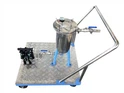
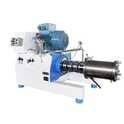
Particle size distribution plays a crucial role in various industries, especially those dealing with fine chemicals, pharmaceuticals, paints, inks, and many others. As a leading supplier of Pin Type Bead Mills, we are often asked about the achievable particle size distribution with our equipment. In this blog post, we will explore the factors that influence particle size distribution in a Pin Type Bead Mill and the typical results that can be expected.
Understanding the Pin Type Bead Mill
A Pin Type Bead Mill is a high - energy milling device used for wet grinding and dispersing. It consists of a grinding chamber filled with grinding beads, usually made of materials such as zirconia, glass, or ceramic. The chamber has pins or discs attached to a rotating shaft. As the shaft rotates, the pins or discs agitate the grinding beads, creating high - shear forces that break down the particles in the slurry being processed.
The working principle of a Pin Type Bead Mill is based on the collision and friction between the grinding beads and the particles in the slurry. When the slurry is pumped into the grinding chamber, the high - speed rotation of the pins causes the beads to move randomly, impacting and shearing the particles. This continuous action reduces the particle size over time.
Factors Affecting Particle Size Distribution
Several factors influence the particle size distribution achievable with a Pin Type Bead Mill. These factors need to be carefully considered and optimized to obtain the desired results.
1. Grinding Media
The type, size, and density of the grinding media have a significant impact on particle size distribution. Smaller beads generally produce finer particles because they can provide more contact points and higher shear forces. For example, using zirconia beads with a diameter of 0.1 - 0.3 mm can achieve much finer particle sizes compared to using 1 - 2 mm beads. However, smaller beads also have a higher risk of clogging and erosion.
The density of the grinding media also matters. Higher - density media can produce more energy during the grinding process, which is beneficial for breaking down hard particles. Zirconia beads, with their high density, are often preferred for applications where fine grinding is required.
2. Rotor Speed
The rotor speed of the Pin Type Bead Mill determines the intensity of the grinding action. A higher rotor speed means greater shear forces are applied to the particles in the slurry. However, there is a limit to how fast the rotor can spin. Excessive rotor speed can lead to over - heating of the slurry, increased wear of the grinding chamber and pins, and even damage to the particles. Therefore, an optimal rotor speed needs to be selected based on the properties of the material being processed and the type of grinding media used.
3. Feed Rate
The feed rate of the slurry into the grinding chamber is another critical factor. A lower feed rate allows the particles to spend more time in the grinding chamber, increasing the probability of particle - bead collisions and resulting in finer particle sizes. On the other hand, a very high feed rate may cause incomplete grinding, leading to a broader particle size distribution.
4. Slurry Viscosity
The viscosity of the slurry affects the movement of the grinding beads and the particles within the grinding chamber. High - viscosity slurries can impede the movement of the beads, reducing the grinding efficiency. Therefore, it is often necessary to adjust the viscosity of the slurry by adding solvents or dispersants to ensure proper grinding and narrow particle size distribution.
Typical Achievable Particle Size Distribution
The achievable particle size distribution with a Pin Type Bead Mill can vary widely depending on the above - mentioned factors and the nature of the material being processed.
In general, for relatively soft materials such as pigments used in Ink Bead Mill applications, a Pin Type Bead Mill can achieve a median particle size (d50) in the range of 100 - 500 nanometers. The particle size distribution can be quite narrow, with a span (defined as (d90 - d10)/d50) of less than 1 in some cases.
For harder materials like titanium dioxide in Titanium Dioxide Bead Mill applications, achieving a d50 of 200 - 800 nanometers is common. While the size reduction is more challenging, careful optimization of the grinding parameters can still result in a relatively narrow particle size distribution.


In Laboratory Bead Mill settings, where smaller - scale experiments are carried out, the Pin Type Bead Mill can be used to precisely control the particle size distribution for research and development purposes. It allows scientists and engineers to study the effects of different grinding conditions on the final product characteristics.
Examples of Industrial Applications
Ink Industry
In the ink industry, precise particle size distribution is crucial for the quality of the final product. A uniform particle size ensures good printability, color strength, and dispersion stability. Our Pin Type Bead Mills are widely used in ink production to achieve the desired particle size distribution, typically in the sub - micron range. This results in high - quality inks that are suitable for various printing techniques, such as offset, gravure, and flexographic printing.
Pharmaceutical Industry
In pharmaceuticals, the particle size of active ingredients can significantly affect the bioavailability and solubility of drugs. With our Pin Type Bead Mills, pharmaceutical manufacturers can produce drug particles with a narrow size distribution, ensuring consistent dosing and better therapeutic effects.
Paint Industry
In the paint industry, particle size distribution affects the gloss, hiding power, and durability of paints. By using a Pin Type Bead Mill to achieve a fine and uniform particle size, paint manufacturers can produce high - performance paints that meet the demands of different customers.
Advantages of Our Pin Type Bead Mills
Our company's Pin Type Bead Mills offer several advantages in achieving optimal particle size distribution.
- High - precision Grinding: Our mills are designed with advanced technology to provide precise control over the grinding process. The pin design ensures efficient energy transfer to the grinding media, resulting in uniform particle size reduction.
- Customizable Settings: We understand that different applications require different grinding parameters. Our Pin Type Bead Mills can be easily adjusted to meet the specific needs of each customer, including rotor speed, feed rate, and bead size.
- Durable Construction: Our mills are built with high - quality materials to withstand the harsh conditions of continuous grinding. The wear - resistant components ensure a long service life and reliable operation.
Conclusion and Call to Action
In conclusion, a Pin Type Bead Mill is a powerful tool for achieving narrow and precise particle size distributions in a wide range of industrial applications. By carefully controlling factors such as grinding media, rotor speed, feed rate, and slurry viscosity, it is possible to obtain the desired particle size for various materials.
If you are interested in learning more about our Pin Type Bead Mills or need help in achieving the optimal particle size distribution for your specific application, we invite you to contact us for a consultation. Our team of experts is ready to provide you with detailed information and support to meet your processing needs.
References
- S. M. Koseoglu, "Particle Size Reduction in Wet Bead Milling: A Review", Journal of Food Engineering, Vol. 105, No. 3, pp. 409 - 420, 2011.
- R. B. McKay, "The Principles of Wet Grinding in Bead Mills", Powder Technology, Vol. 102, No. 2 - 3, pp. 147 - 156, 1999.
- J. F. Briesen, "Particle Size Distribution in Grinding Processes", Chemical Engineering Science, Vol. 56, No. 1, pp. 339 - 348, 2001.