Hey there! As a provider of Turbo Type Bead Mills, I've been getting a lot of questions lately about how the bead filling rate impacts the grinding efficiency of these awesome machines. So, I thought I'd dive deep into this topic and share my insights with all of you.
First off, let's talk about what the bead filling rate actually means. In a Turbo Type Bead Mill, beads are used as the grinding media. The bead filling rate refers to the volume percentage of the grinding chamber that's filled with these beads. It's a crucial factor that can significantly affect the overall performance and productivity of the mill.
When it comes to the influence on grinding efficiency, a higher bead filling rate generally leads to more contact between the beads and the material being ground. This increased contact surface area allows for more efficient particle size reduction. More beads mean more chances for the particles to collide with the grinding media, which in turn speeds up the grinding process. For example, if you're trying to grind a batch of pigments into a fine powder, a higher bead filling rate can help you achieve a smaller particle size in a shorter period of time.
However, it's not all about stuffing the mill with as many beads as possible. There are some downsides to having an extremely high bead filling rate. One major issue is increased heat generation. As the beads rub against each other and the material during the grinding process, friction is created, which generates heat. When the bead filling rate gets too high, this heat can build up quickly. High temperatures can not only damage the quality of the product you're grinding (like changing the chemical properties of some heat - sensitive materials), but it can also cause wear and tear on the mill components, reducing the lifespan of the machine.
Another problem with an overly high bead filling rate is the potential for clogging. When there are too many beads in the grinding chamber, the flow of the material can be restricted. The material may not be able to move freely through the mill, causing it to accumulate and eventually clog the outlet or other parts of the machine. This not only stops the grinding process but also requires time - consuming maintenance to clear the blockage.
On the other hand, a low bead filling rate also has its drawbacks. With fewer beads, there's less contact with the material, which means slower grinding. You'll have to run the mill for a longer time to achieve the same particle size reduction as you would with a higher filling rate. This not only consumes more energy but also reduces the overall throughput of the mill. Your production capacity will take a hit, and you'll end up spending more on electricity and labor.
To find the optimal bead filling rate, you need to consider several factors. The type of material you're grinding is a major one. Different materials have different physical and chemical properties. For example, if you're grinding a soft material like limestone, you might be able to get away with a slightly lower bead filling rate compared to a hard material like silicon carbide. The hardness, density, and viscosity of the material all play a role in determining the ideal filling rate.


The size of the beads also matters. Smaller beads generally have a larger surface area, which can enhance the grinding efficiency. But when using smaller beads, you might need to adjust the bead filling rate. If you use very small beads, a higher filling rate may be required to ensure sufficient contact with the material.
In my experience as a Turbo Type Bead Mill provider, I've seen that a good starting point for many materials is a bead filling rate of around 70 - 80%. However, this is just a general guideline. You'll need to conduct some tests with your specific material and machine to find the exact optimal filling rate.
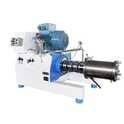
Now, let me tell you a bit more about our Turbo Type Bead Mills. These mills are designed with advanced technology to ensure high - efficiency grinding. They have a unique turbo design that creates a strong centrifugal force, which enhances the grinding action of the beads. Whether you're in the paint, ink, or pharmaceutical industry, our mills can handle a wide range of materials.
If you're interested in other types of bead mills, we also offer the Superfine Horizontal Sand Mill. This mill is great for achieving super - fine particle sizes and is widely used in industries where high - precision grinding is required. Another option is the Titanium Dioxide Bead Mill, which is specifically designed for grinding titanium dioxide and other similar materials. And for those who prefer a disc - shaped design, we have the Disc Type Bead Mill.
In conclusion, the bead filling rate has a big impact on the grinding efficiency of the Turbo Type Bead Mill. You need to strike the right balance to get the best results. If you're facing challenges with bead filling rates or are looking for a high - quality bead mill for your production needs, don't hesitate to reach out. We're here to help you choose the right solution and optimize your grinding process. Whether you're a small - scale manufacturer or a large - scale industrial operation, we can provide the support you need.
So, if you're interested in learning more or want to discuss a potential purchase, just drop us a line. We look forward to helping you take your grinding operations to the next level!
References
- Smith, J. (2020). "Advanced Grinding Technologies in the Manufacturing Industry". Springer.
- Brown, A. (2019). "Optimizing Bead Mill Performance for Different Materials". Journal of Industrial Grinding.