What is the effect of the agitation intensity on the dispersion quality in a Dyes Pigment Bead Mill?
As a dedicated supplier of Dyes Pigment Bead Mills, I've witnessed firsthand the pivotal role that agitation intensity plays in the dispersion quality of dyes and pigments. In this blog post, I'll delve into the intricate relationship between agitation intensity and dispersion quality, shedding light on how it impacts the performance of our bead mills and, ultimately, the end - products of our customers.
Understanding the Basics of a Dyes Pigment Bead Mill
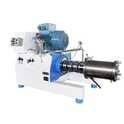
Before we explore the effect of agitation intensity, let's briefly understand what a Dyes Pigment Bead Mill is. A bead mill is a type of grinder used to disperse and grind materials into fine particles. In the context of dyes and pigments, it breaks down agglomerated particles into smaller, more uniformly sized particles, enhancing the color strength, transparency, and stability of the final product.
The bead mill consists of a chamber filled with grinding media (usually beads made of materials like zirconia, glass, or ceramic) and an agitator. The agitator, driven by a motor, rotates at a certain speed, causing the beads to move and collide with the dye or pigment particles. This process of bead - particle interaction is what accomplishes the grinding and dispersion.
The Role of Agitation Intensity
Agitation intensity can be defined by factors such as the rotational speed of the agitator, the design of the agitator (e.g., the shape and number of impellers), and the power input to the agitator. It directly influences the movement and collision frequency of the grinding beads and the dye or pigment particles.
Impact on Particle Size Reduction
One of the most significant effects of agitation intensity on dispersion quality is its influence on particle size reduction. Higher agitation intensity generally leads to more frequent and energetic collisions between the grinding beads and the pigment particles. As a result, larger agglomerates are more effectively broken down into smaller particles.
For instance, when the agitator rotates at a low speed, the movement of the beads is relatively gentle, and the collisions may not be strong enough to break apart large agglomerates. On the other hand, a high - speed agitator can generate a more turbulent flow within the mill chamber, increasing the likelihood of beads hitting the particles with sufficient force to break them down.
However, there is a limit to this effect. If the agitation intensity is too high, it can cause excessive wear on the grinding beads and the mill chamber. Moreover, extremely high - speed agitation may lead to the formation of new agglomerates due to the high - energy collisions causing the small particles to re - aggregate.
Influence on Dispersion Uniformity
Agitation intensity also affects the uniformity of the dispersion. A well - dispersed dye or pigment should have a consistent particle size distribution throughout the mixture. Higher agitation intensity helps in achieving better dispersion uniformity by ensuring that all the particles are exposed to the grinding action of the beads.
In a bead mill with low agitation intensity, there may be areas within the chamber where the flow of beads and particles is less turbulent. This can result in some particles not being adequately ground or dispersed, leading to a non - uniform particle size distribution. In contrast, a high - intensity agitation creates a more homogeneous flow pattern, ensuring that all particles are evenly processed.
Effect on Viscosity and Rheology
The agitation intensity can impact the viscosity and rheology of the dye or pigment dispersion. As the particles are broken down into smaller sizes, the surface area of the particles increases. This can lead to an increase in the viscosity of the dispersion, especially at high agitation intensities.
However, the relationship between agitation intensity and viscosity is complex. In some cases, proper agitation can also help in reducing the viscosity by breaking down the internal structure of the agglomerates and allowing the particles to disperse more freely in the liquid medium. The rheological properties of the dispersion, such as its flow behavior and thixotropy, are also affected by the agitation intensity, which can have implications for the handling and application of the final product.
Practical Considerations for Our Bead Mills
As a supplier of Dyes Pigment Bead Mills, we understand the importance of optimizing the agitation intensity for different applications. We offer a range of bead mills, including Pearl Mill, Bead Mill For Color Paste, and Bead Mill For Flame Retardant, each designed to meet specific customer requirements.
When selecting a bead mill, customers need to consider factors such as the type of dye or pigment, the desired particle size, and the production volume. For example, for applications where a very fine particle size is required, a bead mill with a higher agitation intensity may be more suitable. However, for heat - sensitive pigments, excessive agitation intensity may cause degradation, so a more moderate agitation speed may be necessary.
We also provide technical support to our customers to help them determine the optimal agitation intensity for their specific processes. Our team of experts can assist in adjusting the agitator speed, selecting the appropriate grinding media, and optimizing the mill operation parameters.


Conclusion
In conclusion, agitation intensity is a critical factor in determining the dispersion quality in a Dyes Pigment Bead Mill. It affects particle size reduction, dispersion uniformity, and the rheological properties of the dispersion. As a supplier, we are committed to providing high - quality bead mills that allow our customers to achieve the best possible dispersion results.
If you are in the market for a Dyes Pigment Bead Mill or have any questions about optimizing the agitation intensity for your application, we encourage you to reach out to us. Our experienced team is ready to discuss your specific needs and provide you with the most suitable solutions. Let's work together to enhance the quality of your dye and pigment products.
References
- "Particle Size Reduction and Dispersion in Bead Mills" - Journal of Colloid and Interface Science
- "Effect of Agitation Conditions on the Dispersion of Pigments in Liquid Media" - Industrial & Engineering Chemistry Research
- "Rheological Behavior of Pigment Dispersions in Bead Milling Processes" - Journal of Rheology