Controlling the particle size of ink in a production line is a crucial aspect that directly impacts the quality, performance, and applicability of the final product. As a leading supplier of Ink Production Lines, we understand the significance of this process and have extensive experience in providing solutions to ensure optimal particle size control. In this blog, we will delve into the various factors and methods involved in controlling the particle size of ink during production.
Understanding the Importance of Particle Size in Ink
The particle size of ink particles plays a vital role in determining the ink's properties. Smaller particle sizes generally result in better color strength, gloss, and transparency. They also contribute to improved print quality, as finer particles can produce sharper images and smoother gradients. On the other hand, larger particle sizes may lead to issues such as poor dispersion, clogging of printing nozzles, and reduced print resolution. Therefore, achieving the desired particle size range is essential for meeting the specific requirements of different printing applications.
Factors Affecting Particle Size in Ink Production
Several factors can influence the particle size of ink during production. Understanding these factors is the first step in effectively controlling the particle size.
Raw Materials
The choice of raw materials, including pigments, binders, solvents, and additives, can significantly affect the particle size of the ink. Pigments, in particular, come in various particle sizes and shapes. For example, organic pigments tend to have smaller particle sizes compared to inorganic pigments. The quality and purity of the raw materials also play a role. Impurities in the pigments can cause agglomeration, leading to larger particle sizes. Therefore, it is essential to select high - quality raw materials with consistent particle size distributions.
Mixing and Dispersion
The mixing and dispersion process is crucial for breaking down agglomerates and achieving a uniform particle size distribution. During mixing, the ink components are combined, and mechanical forces are applied to disperse the pigments evenly throughout the binder and solvent system. The type of mixer used, such as a high - shear mixer or a ball mill, can affect the efficiency of the dispersion process. High - shear mixers are capable of generating strong forces that can break down large agglomerates into smaller particles. However, over - mixing can also lead to the formation of new agglomerates or damage to the pigment particles.
Grinding
Grinding is another important step in reducing the particle size of ink. Ball mills, sand mills, and attritor mills are commonly used in ink production for grinding. In a ball mill, the ink is placed in a container along with grinding media (usually ceramic or steel balls). As the container rotates, the grinding media collide with the ink particles, breaking them down into smaller sizes. The size and type of grinding media, the rotation speed of the mill, and the grinding time all affect the final particle size of the ink. Longer grinding times generally result in smaller particle sizes, but this also increases production time and energy consumption.
Temperature and Pressure
Temperature and pressure can also have an impact on the particle size of ink. High temperatures can cause the solvents to evaporate, which may lead to changes in the viscosity of the ink and affect the dispersion of the particles. Pressure can influence the interaction between the ink components and the grinding media during the grinding process. For example, in some high - pressure homogenization processes, the ink is forced through a small orifice at high pressure, which can break down the particles into smaller sizes.
Methods for Controlling Particle Size
Based on the factors mentioned above, several methods can be employed to control the particle size of ink in a production line.
Pre - treatment of Raw Materials
Before the production process begins, the raw materials can be pre - treated to ensure a more consistent particle size. This can involve sieving the pigments to remove large particles or using techniques such as ultrasonic treatment to break down agglomerates. Ultrasonic waves generate high - frequency vibrations that can disrupt the weak bonds between agglomerated particles, resulting in smaller and more uniformly dispersed particles.
Optimizing Mixing and Dispersion Parameters
To achieve the desired particle size, it is necessary to optimize the mixing and dispersion parameters. This includes selecting the appropriate mixer type, adjusting the mixing speed, and controlling the mixing time. For example, a step - by - step mixing process can be used, where the pigments are first pre - dispersed in a small amount of solvent before being added to the main binder system. This can help to prevent the formation of large agglomerates and ensure a more uniform dispersion.
Grinding Optimization
In the grinding process, the parameters such as the type and size of grinding media, the filling ratio of the mill, and the grinding time need to be carefully controlled. For example, using smaller grinding media can result in more efficient grinding and smaller particle sizes. However, very small grinding media may be difficult to separate from the ink after grinding. The filling ratio of the mill, which is the ratio of the volume of the grinding media to the volume of the mill, also affects the grinding efficiency. An optimal filling ratio ensures that there is enough space for the ink to flow and for the grinding media to move freely.
In - line Monitoring and Feedback
Implementing in - line monitoring systems can help to ensure that the particle size of the ink remains within the desired range during production. Laser diffraction particle size analyzers can be used to measure the particle size distribution of the ink in real - time. The data obtained from these analyzers can be used to adjust the production parameters, such as the mixing speed or the grinding time, to maintain the desired particle size. This feedback loop allows for continuous optimization of the production process.
Our Ink Production Lines for Particle Size Control
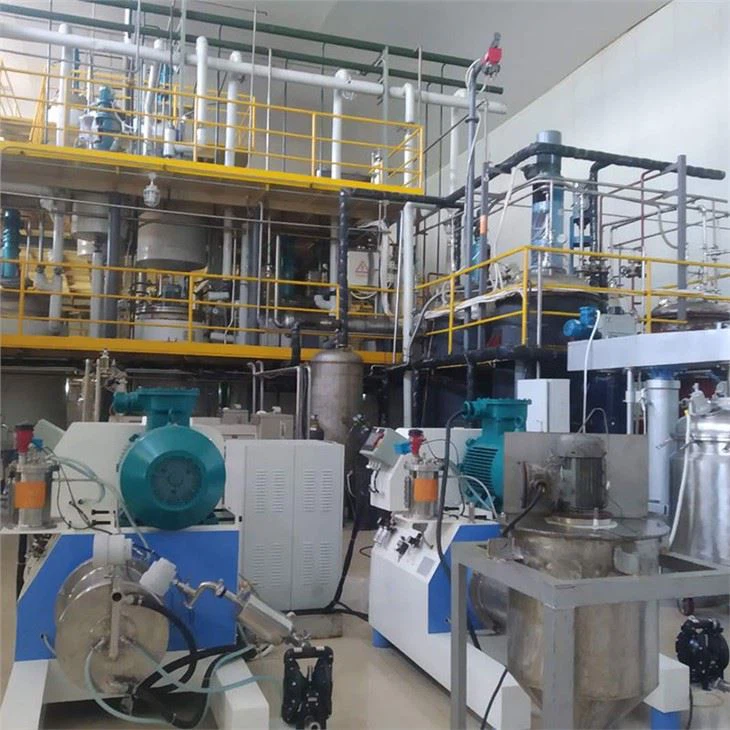
As an Ink Production Line supplier, we offer state - of - the - art production lines that are designed to effectively control the particle size of ink. Our production lines are equipped with high - quality mixers, grinders, and monitoring systems.
Our Paint Production Line shares some similarities with our ink production lines in terms of particle size control. The same principles of mixing, dispersion, and grinding apply, and we have incorporated advanced technologies to ensure consistent particle size distributions in both ink and paint production.

Our Graphene Production Line also utilizes similar techniques for particle size control. Graphene, with its unique properties, requires precise control of particle size during production, and our production lines are capable of achieving the desired specifications.
In addition, our Calcium Carbonate Production Line has experience in handling materials with specific particle size requirements. The knowledge and technology developed for calcium carbonate production can be applied to ink production to enhance particle size control.
Conclusion
Controlling the particle size of ink in a production line is a complex but essential process. By understanding the factors that affect particle size, such as raw materials, mixing, dispersion, grinding, temperature, and pressure, and implementing appropriate control methods, it is possible to achieve a consistent and desired particle size distribution. Our Ink Production Lines are designed to provide reliable solutions for particle size control, ensuring high - quality ink production.
If you are interested in our Ink Production Lines or have any questions about particle size control in ink production, we invite you to contact us for a detailed discussion. We are committed to providing you with the best solutions for your ink production needs.
References
- Patton, T. C. (1979). Paint Flow and Pigment Dispersion: A Rheological Approach to Coating and Ink Technology. John Wiley & Sons.
- Stoy, D. (2001). Inkjet Printing: Principles and Chemical Properties. CRC Press.
- Gumpert, J., & Michaeli, W. (2004). Mixing in Polymer Processing. Hanser Publishers.