Can a Mixing Reactor Be Used for Three - Phase (Gas - Liquid - Solid) Mixing?
In the field of chemical engineering and industrial manufacturing, the efficient mixing of different phases is a fundamental yet complex process. Three - phase (gas - liquid - solid) mixing appears in a wide range of applications, from the food and beverage industry to more complex chemical processes. As a provider of high - quality Mixing Reactors, we are often asked whether our mixing reactors can be used for three - phase mixing. In this blog, we'll explore the capabilities of our mixing reactors in three - phase mixing scenarios.
Understanding Three - Phase Mixing
Three - phase mixing involves the homogeneous dispersion and interaction of a gas, a liquid, and a solid within a confined space. The solid can vary in nature, from catalysts in chemical reactions to particles in food products. The gas might be an inert gas used to facilitate chemical reactions or create a specific environment, while the liquid could serve as a solvent or a reaction medium.
The challenges in three - phase mixing are multi - fold. There is a need to ensure proper dispersion of the gas bubbles throughout the liquid to maximize gas - liquid contact, which is crucial for mass transfer processes. At the same time, the solid particles need to be suspended uniformly in the liquid to prevent settling and promote efficient reactions. Each phase has distinct physical properties, such as density, viscosity, and surface tension, which can significantly affect the mixing process.
The Working Principle of Our Mixing Reactors
Our mixing reactors are designed with advanced engineering principles to handle various mixing tasks. They are equipped with powerful agitation systems that can generate high - intensity flow patterns within the reactor. The design of the impellers is optimized to provide a combination of radial and axial flow, which helps to distribute the energy evenly throughout the reactor volume.
The reactor's structure allows for the introduction of the three phases in a controlled manner. The gas can be injected through specialized spargers, which are designed to create small, uniformly sized bubbles. This enhances the gas - liquid interfacial area and thus improves mass transfer. The liquid enters through dedicated inlets, and the solid can be loaded either before or during the operation, depending on the nature of the process.


Advantages of Using Our Mixing Reactors for Three - Phase Mixing
- Efficient Mass Transfer: The well - designed agitation system in our mixing reactors promotes efficient mass transfer between the gas, liquid, and solid phases. The high - intensity flow created by the impellers helps to break up large gas bubbles into smaller ones, increasing the gas - liquid contact area. This is essential for reactions such as hydrogenation, where the transfer of hydrogen (gas) to the liquid phase is a crucial step.
- Uniform Solid Suspension: Maintaining a uniform suspension of solid particles in the liquid is a critical aspect of three - phase mixing. Our reactors are capable of generating sufficient shear forces to keep the solid particles suspended, preventing them from settling at the bottom. This is particularly important in catalytic processes, where the catalyst (solid) needs to be in constant contact with the reactants in the liquid and gas phases.
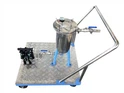
- Scalability: Our mixing reactors are available in a range of sizes, from small laboratory - scale units to large industrial - scale Movable Tank and Vessel. This scalability allows for easy transition from pilot - scale experiments to full - scale production, ensuring that the mixing performance is consistent across different scales.
- Flexibility: Our mixing reactors can be customized to meet the specific requirements of different three - phase mixing applications. For example, the reactor can be equipped with different types of impellers depending on the viscosity of the liquid and the size of the solid particles. Additionally, the temperature and pressure within the reactor can be precisely controlled to optimize the reaction conditions.
Factors Affecting Three - Phase Mixing in Our Reactors
Although our mixing reactors are well - suited for three - phase mixing, there are several factors that can influence the mixing performance.
- Physical Properties of the Phases: The density, viscosity, and surface tension of the gas, liquid, and solid phases play a significant role in the mixing process. For instance, a highly viscous liquid may require a more powerful agitation system to achieve proper mixing. Similarly, large and heavy solid particles may be more difficult to suspend compared to smaller, lighter particles.
- Reactor Geometry: The shape and size of the reactor can affect the flow patterns and mixing efficiency. A well - designed reactor geometry can help to minimize dead zones and ensure uniform mixing throughout the reactor volume.
- Agitation Speed: The speed of the agitator is a critical parameter in three - phase mixing. Too low an agitation speed may result in poor mixing and insufficient suspension of the solid particles, while too high a speed can lead to excessive power consumption and potential damage to the reactor components.
Case Studies of Three - Phase Mixing with Our Reactors
- Catalytic Hydrogenation: In a chemical plant, our mixing reactor was used for the catalytic hydrogenation of an organic compound. The catalyst (solid) was suspended in the liquid reactant, and hydrogen gas was introduced into the reactor. The efficient mixing in the reactor ensured a high rate of hydrogen transfer to the liquid phase and good contact between the catalyst and the reactants. As a result, the reaction rate was significantly increased, and the product yield was improved.
- Food Processing: In a food manufacturing company, our reactor was employed for the production of a particulate - containing beverage. The solid particles (such as fruit pulp) needed to be uniformly distributed in the liquid, and the dissolved gas (carbon dioxide) had to be maintained at a specific level. Our mixing reactor was able to achieve the desired level of three - phase mixing, resulting in a product with a consistent texture and quality.
Conclusion
In conclusion, our Mixing Reactors are indeed capable of handling three - phase (gas - liquid - solid) mixing. The advanced design, efficient agitation systems, and flexibility of our reactors make them suitable for a wide range of applications. Whether it's for chemical reactions, food processing, or other industrial processes, our reactors can provide the necessary mixing performance to ensure high - quality products.
If you are involved in a process that requires three - phase mixing and are considering a mixing reactor, we encourage you to contact us for further discussion. Our technical experts are available to provide detailed information and assist you in selecting the most suitable reactor for your specific needs. We look forward to the opportunity to work with you and contribute to the success of your projects.
References
- Levenspiel, O. (1999). Chemical Reaction Engineering. Wiley.
- Perry, R. H., & Green, D. W. (2008). Perry's Chemical Engineers' Handbook. McGraw - Hill.
- Walas, S. M. (1995). Reaction Kinetics for Chemical Engineers. Butterworth - Heinemann.