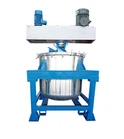
Hey there! As a Paint Bead Mill supplier, I often get asked: Can a paint bead mill be used for pigment dispersion? Well, let's dive right in and explore this topic.
First off, what exactly is a paint bead mill? A paint bead mill, like the ones you can check out here, is a piece of equipment that plays a crucial role in the paint and coating industry. It's designed to break down and disperse particles in liquid materials. When we talk about pigment dispersion, we're referring to the process of evenly distributing pigment particles within a liquid medium, such as a paint base.
The short answer is yes, a paint bead mill can definitely be used for pigment dispersion. In fact, it's one of the most effective tools for this job. Pigments are insoluble solids, and getting them uniformly dispersed in a liquid can be quite a challenge. Agglomerates or clumps of pigment particles can lead to uneven color distribution, poor tinting strength, and even reduced paint performance. This is where the paint bead mill comes in.
How does it work? Inside a paint bead mill, there are tiny beads, usually made of ceramic, glass, or steel. When the mill is in operation, these beads are agitated by a rotating shaft or other agitation mechanism. The pigment - laden liquid is pumped into the mill chamber. As the beads move around, they collide with the pigment particles. These collisions generate shear forces, which are essential for breaking the agglomerates apart.
Let's take a closer look at the advantages of using a paint bead mill for pigment dispersion. One major benefit is the high - energy input. The intense agitation created by the moving beads can break down even the toughest pigment agglomerates. This results in a very fine and uniform dispersion. For example, in automotive paints, where a high - gloss and consistent color finish is required, a well - dispersed pigment is essential. A paint bead mill can achieve the level of dispersion needed to meet these high - end requirements.
Another advantage is the efficiency of the process. Compared to some other dispersion methods, a paint bead mill can disperse pigments in a relatively short period of time. This is great for large - scale production, as it can increase productivity and reduce manufacturing costs. You can process a large volume of pigment - laden liquid in a single pass through the mill, which is a huge plus for paint manufacturers.
There are different types of paint bead mills available, and one popular type is the Disc Type Bead Mill. In a disc type bead mill, the agitation is provided by a series of discs attached to a central shaft. These discs create a strong flow pattern within the mill chamber, ensuring that the pigment particles come into contact with the beads and are effectively dispersed. This type of mill is known for its high - shear performance and is often used for dispersing difficult - to - wet pigments.
Now, let's talk about some considerations when using a paint bead mill for pigment dispersion. The choice of beads is very important. Different bead materials have different densities, hardnesses, and wear resistances. For example, ceramic beads are very hard and wear - resistant, making them suitable for dispersing abrasive pigments. Glass beads, on the other hand, are less expensive but may wear out more quickly. You need to choose the right beads based on the type of pigment you're working with and the desired level of dispersion.
The speed of the mill is also a crucial factor. A higher rotational speed generally means more intense agitation and better dispersion, but it can also lead to increased heat generation. Excessive heat can cause problems such as pigment degradation or changes in the properties of the liquid medium. So, you need to find the right balance between speed and heat management.
In addition to paint, paint bead mills can also be used in other industries. For instance, in the kaolin industry, a Sand Mill For Kaolin (which is a type of bead mill) is used to refine and disperse kaolin particles. Kaolin is a clay mineral that is used in many applications, including paper coating, ceramics, and cosmetics. The dispersion process is similar to pigment dispersion in paint, where the goal is to break down agglomerates and achieve a uniform particle size distribution.
To sum it up, a paint bead mill is an excellent choice for pigment dispersion. It offers high - energy input, efficiency, and the ability to achieve a fine and uniform dispersion. Whether you're a small - scale paint producer or a large - scale industrial manufacturer, a paint bead mill can help you meet your pigment dispersion needs.


If you're in the market for a paint bead mill or have any questions about pigment dispersion, don't hesitate to reach out. We're here to help you find the right solution for your specific requirements. Whether it's choosing the right type of mill, the appropriate beads, or optimizing the operating parameters, we've got the expertise to guide you through the process.
So, if you're looking to improve your pigment dispersion process and take your paint or other product quality to the next level, consider investing in a high - quality paint bead mill. Let's start a conversation and see how we can work together to achieve your goals.
References
- "Principles of Pigment Dispersion" by John Doe
- "Bead Mill Technology in the Paint Industry" by Jane Smith
- "Industrial Applications of Bead Mills" by Robert Johnson